How to Fix Slow Response Times in a Discord Community When the Answer Lives in Another Team
Most unanswered questions are not a moderator shortage. They are waiting on fulfillment, finance or engineering, and what breaks changes at every size of community.

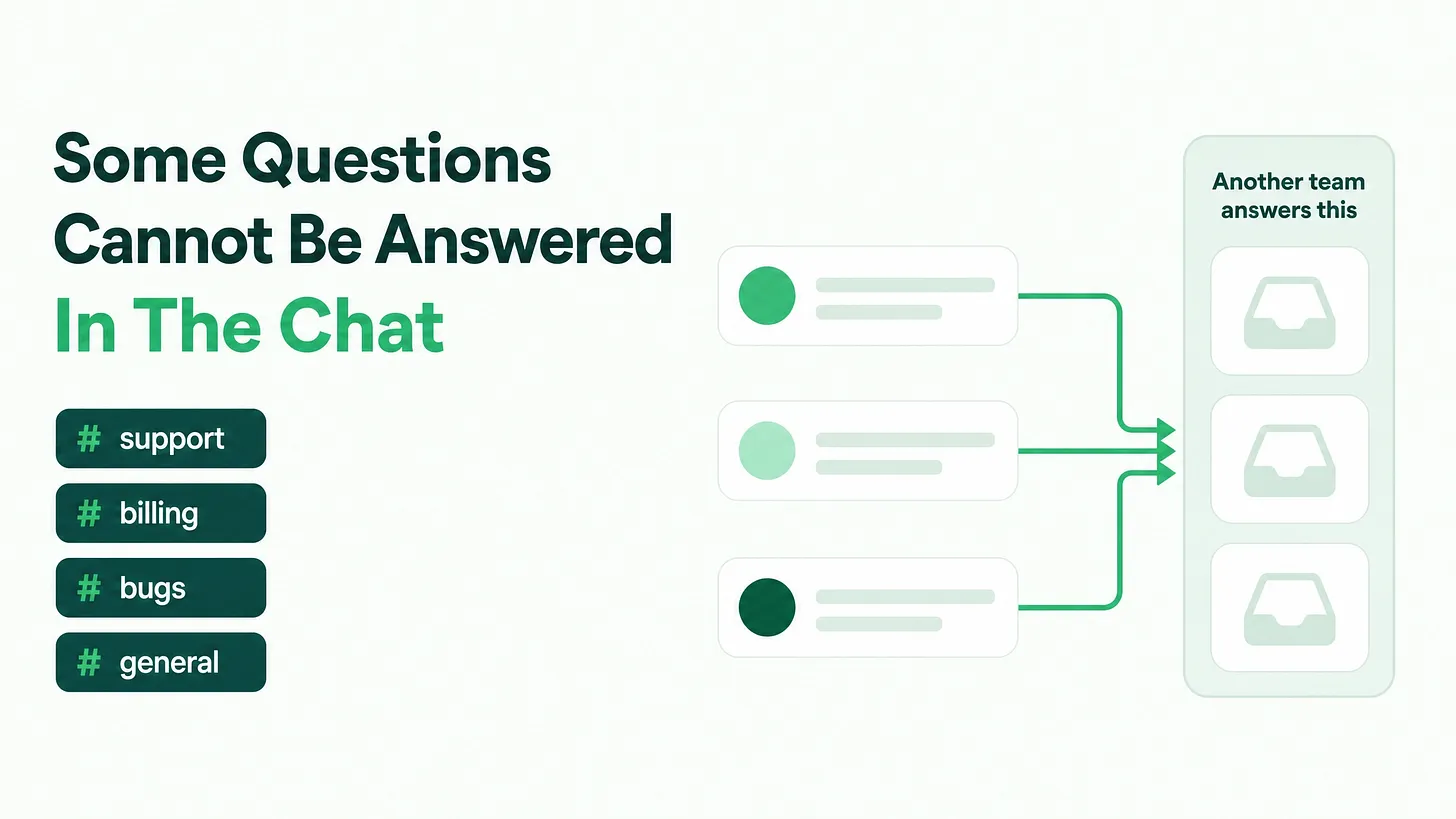
| If you want to know how to fix slow response times in a Discord community, stop counting moderators and start sorting questions. Many of the ones that sit for days cannot be answered by anybody in the chat, because they need fulfillment, finance or engineering to check something. Measure first response and resolution separately, then give every outside topic a named owner and a stated turnaround. |
|---|
The short answer
Sort your unanswered questions into two piles before you change anything else. Pile one is everything a person in the server could have answered with what they already know. Pile two is everything that required somebody outside the server to go and look something up. Where is my order. Why was I charged twice. When does the fix ship. Is my refund approved. Pile one is a staffing and coverage problem, and more people or better hours will fix it. Pile two will not move no matter how many moderators you add, because the moderators were never the bottleneck. They were waiting, exactly like the member was. Most teams never do this sort. They see a slow number, assume the community team is understaffed, hire another moderator, and the number barely moves. Then the community team gets treated as the underperformer, when the delay was sitting in a queue two departments away the whole time.
A moderator who cannot answer a question is not slow. They are blocked, and blocked is a different problem with a different fix.
Two clocks, not one
The single reason this stays invisible is that most communities report one number. Average response time. It blends two things that belong to two different owners.
| Clock | What it measures | Who owns it | What actually fixes it |
|---|---|---|---|
| Time to first human response | How long before a real person acknowledges the member | The community team | Coverage hours, staffing, alerting |
| Time to resolution | How long before the member has their actual answer | The business function that holds the answer | Named owners, agreed turnarounds, escalation paths |
Split them and the conversation changes immediately. A first response time of a few minutes and a resolution time of four days tells you the community team is doing its job and the handoff behind it is broken. A first response time of a day tells you the opposite. One blended number tells you nothing and quietly assigns blame to whoever is closest to the member. Track them separately from this week, even if you do it by hand in a spreadsheet. The split is worth more than any tooling you might buy.
Under 1,000 members: the shoulder tap still works
At this size one person usually answers everything. When a question needs somebody else, they walk over, send a message, and get an answer because the company is small enough that everyone knows everyone and nobody wants to be the person who ignored a customer. Nothing formal is needed here and building it early is wasted effort. What you should do at this size is start writing down which questions had to leave the server and who answered them. It takes seconds and it becomes the foundation for everything below. The list you keep at 500 members is what saves you at 10,000. The failure at this size is not slowness. It is that nothing gets recorded, so when the volume arrives there is no map of who answers what.
Around 1,000 members: the favour economy breaks
This is the first real threshold, and it catches most teams by surprise because nothing dramatic happens. Volume just crosses the point where asking colleagues for help stops being occasional and starts being constant. Now the requests are a stream of direct messages to people who never agreed to be part of the support process. They answer when they have time, which means the member's wait depends on somebody else's calendar. Nobody is behaving badly. The arrangement simply has no agreement inside it. What to put in place here:
- One shared place where outside questions go, not personal direct messages.
- A short written note of who answers what, agreed with those people rather than assumed.
- A rough expectation of how long each type takes, so the community team can tell the member something true. That last point matters more than it sounds. "Someone is checking, you will hear back today" holds a member. Silence does not, and silence is what you get when the community team has no idea how long the other team will take.
Around 10,000 members: named owners and stated turnarounds
At this size goodwill stops being enough and the structure has to become explicit. Every category of outside question gets one named owner and one stated turnaround. Not a rota of moderators. A person in fulfillment who owns order questions. A person in engineering who owns bug confirmations. A person in finance who owns billing disputes. Write it as a plain table that anybody can read:
| Question Type | Owner (Role) | Answer Within |
|---|---|---|
| Order and delivery | Fulfillment coordinator | 1 business day |
| Billing and refunds | Finance operations | 2 business days |
| Bug confirmation | Engineering on-call | 1 business day |
| Account and access | Support lead | 4 hours |
| Legal and policy | Operations manager | 3 business days |
Two things make this work. The turnaround is agreed by the owner rather than imposed on them, and the community team is allowed to say the turnaround out loud to the member. A member told "billing questions come back within two working days" waits calmly. The same member with no information assumes they were ignored and says so publicly. This is also the size where the community team should stop being measured on resolution time for things it cannot resolve. Report the two clocks separately at this point or the wrong team keeps absorbing the criticism.
100,000 members and above: escalation has to become a ticket
At large scale, a message asking a colleague for a favour stops surviving contact with volume. The owner has their own queue, their own priorities and their own manager, and a request that lives in a chat message loses to a request that lives in their own system. So the escalation stops being a message and becomes a record in the receiving team's tooling, created automatically, carrying the member's context, with a state the community team can read without asking. The community side keeps one thread with the member and one link to that record.
What changes concretely at this scale?
- Escalations are created as records in the owning team's system rather than sent as messages.
- Each record carries the member reference, the question, and what has already been checked, so nobody re-asks.
- The community team can see the state of every open escalation without pinging anyone.
- Anything past its stated turnaround appears on a list that a manager reviews, not in somebody's memory. The cost of getting this wrong grows with size in a way that is easy to miss. At a thousand members a dropped escalation is one annoyed person. At scale it is a visible thread that other members read, answer for you incorrectly, and remember.
The one week audit
You do not need any of the above to start. You need one week of honest tagging, and it costs nothing.
- For seven days, log every question that did not get resolved the same day.
- Against each one, write the team that would have had to answer it.
- Mark whether the member got any human acknowledgement while they waited.
- At the end of the week, count the entries by team rather than by day.
- Take the two teams with the most entries and agree a named owner and a turnaround with each. What comes back is almost never a list of community problems. It is a picture of which parts of the business your members are actually waiting on, and it is far more persuasive in a leadership conversation than any request for another moderator.
What this layer sits inside
Escalation is one layer of response time and it is the one most often missed, but it is not the whole system. Coverage hours decide whether anybody is awake when the question arrives. Channel and role architecture decides whether the question lands somewhere visible. Documentation decides how many questions never need a human. Automation decides what gets acknowledged instantly. Reporting decides whether any of it is visible to the people funding it. Fix escalation and the questions that need another department stop disappearing. The other layers stay exactly as built or unbuilt as they were, and it is worth knowing which of them you have.
The fastest support teams are not the ones that type quickest. They are the ones where every question already has a person whose job it is to answer it. Read more at danieljeong.org.